Newsletter: PERB updates & changes to working conditions

cropped-us-logo.pngIn this newsletter, we seek to provide updates on the status of our unionization efforts and an update on campus news. As always, please reach out to us if you have any questions! We can be reached at unitesummitteachers@gmail.com.   

A review of our current status:

The Public Employment Relations Board has assigned an attorney to our case. That attorney will set up a meeting between Unite Summit and Summit administration in the near future to resolve the issues concerning residents and the non-teaching staff based in the Home Office.  

We are hopeful that coming out of this meeting, Summit will recognize our union and we can begin bargaining our contract.

For more details, please see our April 17 and April 9 newsletters.

An update on part-time work:

Now that we have formed Unite Summit, administration can’t make changes to working conditions without bargaining with our union. However, Summit seems to be interpreting this in an overly broad manner. We have heard from a few teachers seeking to switch to part-time work or make other changes in their jobs for next year that Summit has told them that changes cannot be made because of the unionization process. We are working with these teachers to clarify to Summit HR that if a teacher and Summit mutually decide to change to part-time work, our union does not consider this something that needs to be bargained over.

If you are having any issues with your contract for next year or have any other questions, please email us at unitesummitteachers@gmail.com or talk with a member of the organizing committee.

Possible schedule changes:

We’ve been hearing conflicting messages over the past month about changes to schedules SPS wants to make in order to unify scheduling across different sites. These attempts at schedule changes have been met with different feelings from staff members across sites, since a unified schedule would be a bigger change for some campuses then for others. We have clearly communicated to Summit administration that any changes in scheduling would be a change in working conditions. If Summit wants to make changes, we ask that teachers be a part of that decision-making process by bargaining those changes with our union. If you have any feedback on the schedule change (positive or constructive), or other changes in working conditions, feel free to reach out to US so that we can understand the needs of our community and advocate on your behalf. The goal is for Unite Summit and Summit leaders to work together to ensure sustainable working conditions for teachers and therefore better school environments for students.

Campus Spotlights: Expeditions:

Expeditions has begun its end-of-year push, which includes after-school showcases at each of our sites. The team started at Shasta. Click here for student journalist coverage of the event, a newsletter, and an interactive catalog of Expeditions courses.We’re working to create personalized catalogs for as many sites as possible, so look out for those links as you prepare to help your mentees through the course selection process! Here’s the Expeditions catalog for Rainier and the coverage of their Celebration of Learning. The Expeditions team greatly appreciates all the support we receive from core teachers who attend these events!

We would like to spotlight important news from each of our campuses! If you have news from your campus that you would like to see us include in a future newsletter, please let us know at unitesummitteachers@gmail.com.

Show your support for our union!

Some sites will be wearing US stickers (with the same logo from this newsletter) to show their support of our union. If you are interested in receiving stickers or pins for yourself or other members on your site, please reach out to your Organizing Committee member! If you are comfortable being featured on our next newsletter or website, please send us a picture of yourself and/or teammates with these pins/stickers and/or a “I support Unite Summit because…” picture that we could add to our gallery!

Please don’t hesitate to ask questions, voice concerns or praises from your school sites- you can email unitesummitteachers@gmail.com, or visit our website at https://unitesummitteachers.wordpress.com!

Newsletter: PERB updates & campus spotlights

cropped-us-logo.pngIn this newsletter, we seek to provide updates on the status of our unionization efforts and an update on campus news. As always, please reach out to us if you have any questions! We can be reached at unitesummitteachers@gmail.com.   

A review of our current status

As you may remember, Summit denied recognition of our union because of its inclusion of residents, and we remain concerned that Summit is attempting to add almost 100 non-teaching staff from the Home Office. So, right now, the Public Employment Relations Board is investigating which job classifications should be covered by our union. As part of this process, a lawyer from PERB may convene a meeting with Unite Summit and Summit administration to try to resolve the issue. We hope to come to an agreement and be recognized as the exclusive representative so we can begin bargaining our contract. If we don’t come to agreement, PERB will make a ruling about which jobs should be included in our bargaining unit. As a reminder, 75% of teachers signed our unionization petition, and PERB already ruled that we have majority support for our union. This means that we will be recognized as the “exclusive representative” either by Summit or by PERB. We will continue through the PERB recognition process and are confident that our union will be officially recognized soon.

For more details, please see our April 17 and April 9 newsletters.

Campus Spotlights: Denali and K2

We would like to spotlight important news from each of our campuses! We’re starting this week with Denali High School and K2. If you have news from your campus that you would like to see us include in a future newsletter, please let us know at unitesummitteachers@gmail.com.

Denali High School: Congratulations to Summit Denali, who just got approved to build their permanent campus by the Sunnyvale City Council! This was the result of years of planning and effort, including input from Denali staff and students! If you have any input about how you would like to advocate for the best use of this new building, let us know by filling out this survey! This could be anything from classroom allocation, break spaces/supervision timing, provision of supplies/furniture, or any other aspect of your work environment! Unite Summit is committed to advocating for the best use of this space to serve students!

K2: Last week, teachers from K2 High School and K2 Middle School submitted a proposal to SPS Leadership requesting a role in the hiring process for new leadership at their schools. The proposal requested immediate action to allow teachers to process the impact of this turn-over. In addition, the proposal requests that finalists 1) shadow the campus for an entire day, 2) candidates meet a panel of colleagues, parents, and/or students. This process utilized the SPS’ Status – Target – Proposal model and was completed by consensus. Faculty were given 30 minutes during the weekly LT meeting to discuss: Mission Moments; 2 or 3 pain points and how to address them; desired qualities of a new school leader.

Show your support for our union!

Some sites will be wearing US stickers (with the same logo from this newsletter) to show their support of our union. If you are interested in receiving stickers or pins for yourself or other members on your site, please reach out to your Organizing Committee member!

Please don’t hesitate to ask questions, voice concerns or praises from your school sites- you can email unitesummitteachers@gmail.com, or visit our website at https://unitesummitteachers.wordpress.com!

Newsletter: Proposed schedule changes and legislation updates

cropped-us-logo.pngIn this newsletter, we seek to provide updates on how you can become involved in our organizing efforts and on the progress of current charter school legislation. As always, please reach out to us if you have any questions! We can be reached at unitesummitteachers@gmail.com.   

Possible changes for next school year

When teachers from the Unite Summit organizing committee met with Diane and Anson earlier this month, we told them we are seeking a transparent and collaborative communication process, as we now have the right to be notified of potential changes to working conditions before they happen, discuss these changes with Summit administration, and even bargain over these changes.

One of these potential changes is the standardizing of all school schedules. We reached out to Diane and Anson last week to request more information about any changes to working conditions for next school year by April 22.

In response, Diane wrote: “As we shared on April 8th, we remain intent on complying with our legal obligations and have not made any changes to the terms and conditions of employment. If and when Summit decides to make any changes to the terms and conditions of employment we will adhere to our legal obligations.”

We want to make sure that teachers have a seat at the table when important decisions are made. While Diane’s email indicates that there will not be changes, as of now, to the schedule for next year, we are still continuing to collect testimonials from members who want to have their voices heard on this issue. Please use this form, or email unitesummitteachers@gmail.com, if you would like to contribute your perspective.

Bargaining team elections

We are looking for volunteers to join each site’s Contract Action Team. Members of that team will help the bargaining team representative by collecting input as needed throughout the bargaining process, and will work to make sure all teachers at that site are fully informed as bargaining progresses. Please reach out to your site organizers if you’re interested in that role!

The following teachers have been elected by their peers to represent their campus. Elected bargaining team members will attend bargaining meetings with SPS representatives once the contract negotiation process begins.


Summit Rainier:

Elected: Isela Mosqueira, Spanish

Expeditions:

Elected: Liz DeOrnellas, Journalism

Denali Middle School:

Elected: Sara Ragey, English

Denali High School:

Elected: Andrew Stevenson, Science

Tam Middle School:

Elected: Matthew Ploch, Expeditions

Tam High School:

Elected: Synclair Young, SPED

K2 Middle School:

Elected: Haley Ralph (Holt), History

K2 High School:

Elected: Brendan Boland, English

Summit Prep:

Dan McClure, Science

Everest:

Evan Anderson, Science

Upcoming elections:

TBD: Shasta, Tahoma

For more information, contact:

Shasta: Sarah Day Dayon

Tahoma: Morris Shieh

Updates on charter school legislation

Charter legislation continues to make its way through Sacramento. There have been some amendments to the bills since our last update, which we’ve listed below. We’ve also linked to the latest versions of the bills (as of the morning of April 22nd).

AB 1505

There was a hearing about AB 1505 on April 10th. You can watch the full hearing here, but we wanted to point out one important piece of testimony.

Assemblymember Patrick O’Donnell, the Chair of the Education Committee and one of the authors of AB 1505 said the following:

“If you’re a good charter operator, there is nothing to worry about in this bill…The intent [of AB 1505] is to allow school districts to consider the fiscal, academic, and facilities impact during the review of a petition for a new charter school or for a school that is expanding enrollment, but not for existing schools.  I am happy to work with all parties to clarify the intent of this and we will address this in future amendments working with all stakeholders.”

Additionally, Assemblymember Bonta, another co-author of the bill, stated that “this bill is not designed or intended to close any existing charter schools, period.” He also said that the consideration of financial, academic, and facilities impact on districts “will only apply to initial authorization, not to renewals.”  

We know that one of the talking points against this bill is that it will shut down existing schools and that a district could choose not to renew a charter due to its negative financial impact on that district. These quotes from the authors of AB 1505 make clear that this is not the intent of the bill, and we expect clarifying amendments in the coming weeks.

The latest version of AB 1505 contains the following amendments:

  • Adds a requirement that charter petitions include the names and qualifications of people nominated to serve on the board of directors of the charter school.
  • Clarifies that if a charter appeals to a County Board (after being denied by a District) and adds new material as part of its appeal, the County Board must send the charter petition back to the District for reconsideration. Under the current charter law, charter schools can’t add new material to their petition when they appeal. This law allows new materials to be added for reconsideration by the local school district.
  • Prohibits the State Board of Education from waiving parts of the law.

AB 1506

The latest version of AB 1506 contains the following amendments:

  • Authorizers (districts, counties, and the state) can’t increase enrollment in a charter after January 1, 2020, unless increases in enrollment had been previously authorized. A new charter that is authorized after that date can only enroll the number of pupils in its initial petition.
  • Prohibits new non-classroom-based charters (basically fully-online or independent study charters — Summit is classroom-based and would not be impacted) after January 1, 2020.
  • Gives preference to new charters run by organizations that are not already operating a school in that district.

AB 1507 and AB 1508 have not been amended since our last update.

SB 756

This bill would create a moratorium on new charter schools, evaluate the moratorium, and lift the moratorium after the completion of the evaluation.

According to the language of the bill, the intent of SB 756 is “to promote the value that the primary function of charter schools is to establish locally driven pedagogical innovation that supports California’s system of public education and does not replace or undermine it. Establishment of a charter school moratorium provides time to reconsider whether the current regulatory framework for charter schools is promoting this value.”

Like AB 1505, this bill is focused on new charters, not existing schools. The bill would prohibit new charters from opening unless the following legislation is passed before January 1, 2020:

  • Charters can only be authorized by the districts in which they are located
  • If a charter does have to locate outside its authorizing district, it can’t locate in another district unless that district agrees
  • The financial, academic, and facilities impact of a new charter will be taken into consideration for authorizing new charters
  • The creation of statewide and district caps on charters

If the above legislation isn’t passed, the moratorium on new charters will be repealed on January 1, 2025.

The bill also requires the Legislative Analyst’s Office (a nonpartisan group of analysts) to evaluate the impact of the charter moratorium and lays out a number of specific research questions the LAO must answer, including:

  • Are charters serving the same number of English learners and students with disabilities as district schools?
  • Has the charter school moratorium led to fewer school closures and program cuts, especially in school districts in which a majority of pupils are pupils of color?
  • How have innovative practices been shared between charter schools and schools of a school district? What was learned and how will the new practice be incorporated into the broader learning community?

There will be a hearing on this bill on April 24.

We are seeking to ensure that all our members are fully informed as we progress through our unionization process. Please reach out to your site organizer or email us at unitesummitteachers@gmail.com if you have questions! You can also subscribe to our website for updates!


Newsletter: Elections and status of residents

cropped-us-logo.pngIn this newsletter, we seek to provide updates on the status of our negotiations and further context around recent developments with the organization.  

Bargaining team elections

The following teachers have been elected by their peers to represent their campus. Elected bargaining team members will attend bargaining meetings with SPS representatives once the contract negotiation process begins.

We are also looking for volunteers to join each site’s Contract Action Team. Members of that team will help the bargaining team representative by collecting input as needed throughout the bargaining process, and will work to make sure all teachers at that site are fully informed as bargaining progresses. Please reach out to your site organizers if you’re interested in that role!

Summit Rainier:

Elected: Isela Mosqueira, Spanish

Expeditions:

Elected: Liz DeOrnellas, Journalism

Denali Middle School:

Elected: Sara Ragey, English

Denali High School:

Elected: Andrew Stevenson, Science

Tam Middle School:

Elected: Matthew Ploch, Expeditions

Tam High School:

Elected: Synclair Young, SPED

K2 Middle School:

Elected: Haley Ralph (Holt), History

K2 High School:

Elected: Brendan Boland, English

Summit Prep:

Dan McClure, Science

Everest:

Evan Anderson, Science

Upcoming elections:

TBD: Shasta, Tahoma

For more information, contact:

Shasta: Sarah Day Dayon

Tahoma: Morris Shieh

Status of the residency program

Last week, the California Commission on Teacher Credentialing heard Summit’s appeal on continuing to operate the resident program.

Here is a summary of the dispute between SPS and CTC regarding the current operation of Summit’s teacher residency program:

  • Under current law, districts and charters can only have intern programs (in which the intern is actually a full-time employee).
  • Only institutes of higher education can run student-teacher (resident) programs. Districts and charters are not allowed to run a student-teacher program, and the Commission on Teacher Credentialing has been consistent on this over the past 20+ years.  
  • It’s much cheaper to pay residents $20,000 than to actually hire them as intern teachers and give them a salary and benefits.
  • Summit got approved for an intern program but in fact did a residency program instead, which districts and charters are not allowed to do.
  • The entity that accredits intern and resident programs noticed that Summit was not running the program they were approved for (they actually found out about this by reading an article in the newspaper).The accreditor told Summit they had to either shut down or actually run the program they were approved for.

In the end, the Commission on Teacher Credentialing ruled that Summit has six months to either: a. partner with an institution of higher learning that’s accredited to do teacher residency programs or b. apply to be an experimental teacher training program. A teacher on the Board of the California Teachers Association sits on the CTC, and she voted in favor of that decision.

A representative from CTA (different from the person on the CTC) said during public testimony that Summit should be allowed to keep operating as an internship program (which is what they were approved for), but that allowing any charter or district to operate its own residency program is not currently lawful and raises larger policy and legal issues. If people want to hear what she said, they can go here: http://stream.ctc.ca.gov/userportal/index.html#/player/vod/R8d1ba528d6d44a99bf919933f6d46010 and fast forward to 03:03:56.

And if you listen to the testimony that follows her, you’ll hear that other stakeholders agree – their objection was not to Summit’s program but to the fact that Summit didn’t follow the same rules that every other charter and district has to follow.

We will keep you updated as this issue develops. We continue to be concerned that resident program, as it was structured this school year, creates too many barriers for folks who want to enter the teaching profession, especially lower income candidates without families to live with or families to support them financially during this time. We are concerned that Summit circumvented the CTC process by not hiring residents as interns (as they were approved to) and not paying them a living wage. Unfortunately, after taxes, residents can earn significantly less than $20,000. The decision of the CTC last week allows Summit to continue training excellent teachers while holding the organization to the same standards as any other school.

Update on recognition petition

On March 21, 2019, PERB notified Unite Summit and Summit Public Schools that Unite Summit demonstrated majority support for our union and that recognition must be granted unless the employer doubts the appropriateness of the bargaining unit (AKA positions covered by our union). SPS denied recognition of our union on April 9, 2019, because they don’t think residents should be included in the bargaining unit (for more context, see above and last week’s newsletter). We also remain concerned that Summit is seeking to add 94 positions to our bargaining unit; those positions consist mainly of Home Office employees, who we feel do not perform the duties of a teacher and are therefore not eligible to be a part of our union.

The Public Employment Relations Board will now investigate which job classifications should be covered by our union. As part of this process, a lawyer from PERB may convene  a meeting with Unite Summit and Summit administration to try to resolve the issue. We hope to come to an agreement and be recognized as the exclusive representative so we can begin bargaining our contract. If we don’t come to agreement, PERB will make a ruling about which jobs should be included in our bargaining unit. Since we have majority support from our colleagues for Unite Summit, we will be recognized as the “exclusive representative” either by Summit or by PERB. We will continue through the PERB recognition process and are confident that our union will be officially recognized soon.

Currently, we are concerned that many of our members have expressed that proposed scheduling changes for next year will make their jobs less sustainable and could affect their decision to remain employed with SPS next school year. We are gathering testimonials from members who want to have their voices heard on this issue. Please use this form, or email unitesummitteachers@gmail.com, if you would like to contribute your perspective. We are working hard to open the lines of communication on this issue. During the unionization process, working conditions are required to remain status quo unless Summit bargains with US to change them.  

We are seeking to ensure that all our members are fully informed as we progress through our unionization process. Please reach out to your site organizer or email us at unitesummitteachers@gmail.com if you have questions! You can also subscribe to our website for updates!


Updates on recognition process and our rights

cropped-us-logo.png

This newsletter seeks to clarify and provide context around the current status of our unionization efforts, the process for moving forward, and the accuracy of recent communications from SPS leaders.

Debate about the composition of our bargaining unit

Unite Summit, CTA and NEA filed an EERA representation petition with the Public Employees Relations Board on 1/25/19. The petition requested recognition of an employee bargaining unit (positions to be included in our union) described as “all certificated educational personnel including but not limited to: certificated teachers, teacher residents, and teachers holding other equivalent documents pursuant to EC section 47605(l).

We included residents in our bargaining unit because we feel that they perform the duties of a teacher and are therefore part of our community of interest. We wish to support our residents in their work toward becoming full-time teachers, and we recognize that SPS hires many residents once they have completed their program.

In their April 8 meeting with US representatives, Diane and Anson refused to answer any questions regarding the reasoning behind excluding residents from the bargaining unit.

Diane and Anson also refused to provide a rationale for why SPS is seeking to add 94 positions to the bargaining unit. Those names consist mainly of Home Office employees. US does not feel that these jobs are analogous to the job of teacher. Furthermore, some of these job titles indicate that these employees have supervisory and managerial responsibilities, which would exclude them from the unit. Here are the job titles included on that disputed list:

  1. 70 names in the job category “managers.” This includes management job assignments such as: special ed, literary interventionist, social studies, program manager, curriculum manager, operations manager, deans.
  2. 20 names in the job category “directors.” This includes directors assigned to professional development, base curriculum, mentor directors, summit learning platform, summit learning growth, district programs, deans.
  3. 2 names in the job category “associate/assistant” This includes a curriculum support manager and ASL support.
  4. 2 names in the job category “senior director” (of the Summit Learning Program)

Next steps in the PERB recognition process

Current status: On March 21, 2019, PERB notified Unite Summit and Summit Public Schools that Unite Summit demonstrated majority support for our union and that recognition must be granted unless the employer doubts the appropriateness of the unit. SPS has until April 9, 2019, to respond. Summit administration has told us they will deny recognition of our union because they don’t think residents should be included (they also included 94 other home office positions that they believe do belong in our union).  

Next steps: Assuming Summit denies recognition, the Public Employment Relations Board will investigate which job classifications should be covered by our union. As part of this process, a lawyer from PERB may convene  a meeting with Unite Summit and Summit administration to try to resolve the issue. We hope to come to an agreement and be recognized as the exclusive representative so we can begin bargaining our contract. If we don’t come to agreement, PERB will make a ruling about which jobs should be included in our bargaining unit. Since we have majority support from our colleagues for Unite Summit, we will be recognized as the “exclusive representative” either by Summit or by PERB. We will continue through the PERB recognition process and are confident that our union will be officially recognized soon.

Our Rights

What are our rights currently?

We have the right to ask for information, be notified by Summit about any changes they plan to make, meet with Summit and give input on any proposed changes, and we will assert we have the right to bargain over any proposed changes to our working conditions.

What will our rights be as the “exclusive representative”?

We will have all the rights we currently have. In addition, we have the right to bargain our union contract and to bargain over any changes to working conditions at any time. We also have the right to elect a bargaining team that will meet during school hours to bargain with Summit administration about our contract.

A letter of support

Assemblymember Ash Kalra wrote this letter in support of our unionization efforts.

Ash Kalra letter.PNG

We are seeking to ensure that all our members are fully informed as we progress through our unionization process. Please reach out to your site organizer or email us at unitesummitteachers@gmail.com if you have questions! You can also subscribe to our website for updates!

Newsletter: Election and legislation updates

US logo

Bargaining Team Elections Update!

We are excited to announce election results from our first round of bargaining team elections! As always, we are aiming to maximize participation, so please reach out to your site organizer if you have not yet held an election on your campus.

Election Results:

Summit Rainier:

Elected: Isela Mosqueira, Spanish

Tam Middle School:

Elected: Matthew Ploch, Expeditions

Denali Middle School:

Elected: Sara Ragey, English

Denali High School:

Elected: Andrew Stevenson, Science

K2 Middle School:

Elected: Haley Ralph (Holt), History

K2 High School:

Elected: Brendan Boland, English

Expeditions:

Elected: Liz DeOrnellas, Journalism

Upcoming elections:

April 11: Summit Prep

TBD: Shasta, Tahoma, Tam High School

For more information, contact:

Shasta: Sarah Day Dayon

Tahoma: Morris Shieh

Tam High School: Angela Wentworth

Everest: Enrique Chante Coon

Elected bargaining team members will attend bargaining meetings with Summit Public Schools representatives once the contract negotiation process begins.

We are also looking for volunteers to join each site’s Contract Action Team. Members of that team will help the bargaining team representative by collecting input as needed throughout the bargaining process and will work to make sure all teachers at that site are fully informed as bargaining progresses. Please reach out to your site organizers if you’re interested in that role!

What happens after elections?

Once members of the bargaining team are elected, their first job will be to generate what is called a “Sunshine Proposal.” This is a requirement under the law that our union shares at a Summit Board meeting all of the topics we plan on negotiating. The Sunshine Proposal will be created by our bargaining team based on the results of the bargaining survey and the comments from the bargaining input meetings.  

Charter School Legislation Update

Summit administration have recently put out information concerning a few bills about charter schools that were introduced this year and has characterized these bills as “anti-charter” and as a threat to the very existence of charter schools.

We want to be clear that these bills do not present that type of threat to our schools. In order for our teachers to be fully informed on these issues, we are providing some more detailed information on these bills to facilitate your own research about whether or not you personally support this legislation.  We understand there can be policy differences about the best way to create the schools our students deserve.  If you have specific questions or suggestions about these pieces of legislation, let us know and we will do our best to get answers.

History of the Charter Schools Act (CSA)

When the California Charter Schools Act (CSA) was passed in 1992, charters were envisioned as small, community-controlled educational experiments designed to create alternative models of education for traditionally underserved students. The creation of charter schools was predicated on greater freedom to innovate in exchange for greater accountability.  The number of charters that could open in California was capped at 100 schools statewide.

By the late 1990s, the cap was essentially lifted, leading to a significant expansion of charter schools (there are now over 1,300 in California) and the creation of new management structures (Charter Management Organizations, or CMOs) that the CSA never contemplated. After over 25 years, people with diverse views on charters agree that it is time to update our outdated charter law to reflect these changes on the ground (even if they disagree on what those updates should be).

Legislation has been introduced this year to update the CSA. While many of the details are still in flux and there will be changes as the bills make their way through the Senate and Assembly, below are the basic concepts for the major bills moving in Sacramento. It should be noted that much of this legislation does not apply to charter renewals.

AB 1505 has multiple parts; its basic intent is to return charter school authorization and oversight to the communities where the charter schools are located. This bill:

    • Limits the appeals process to county boards of education.  Currently, charters that are rejected by a local district can be approved by a county board of education or the State Board of Education. This has allowed charters which had significant problems with academics and finances to be approved by entities that were farther away and less able to do effective oversight. Importantly, there will still be opportunities for appeal to county boards if a district did not follow the law in rejecting a charter.


  • Allows for renewals for less than five years. Under the current law, charter authorizers only have two options: renew a charter for five years or shut it down. This does not give authorizers much flexibility. Changing the renewal time periods would allow authorizers the option to let charters that are struggling have a few more years to improve, rather than just shutting the charter down. The bill also mandates that charter identified for technical assistance must be renewed for less than five years. Finally, this section of the bill mandates that authorizers look at the financial operations of a school when it is up for renewal.
  • Implements technical assistance program for charters. This bill outlines a procedure for technical assistance for charters that are not adequately serving all student groups (for example, bringing in outside experts, reviewing data, developing improvement plans).
  • Updates academic criteria for charter renewal. The current CSA contains academic criteria for renewal that are outdated — we don’t use API rankings anymore, so this has created confusion during the renewal process. The bill would ask the Superintendent of Public Instruction to develop recommendations for updated academic criteria for charter renewal; these recommendations will then go back to the legislature for approval.
  • Changes charter revocation process. The current CSA states that academic achievement is the most important factor in deciding whether or not to revoke a charter. This means that charters with significant financial mismanagement have been able to stay open due to high test scores. This bill would eliminate that part of the law and eliminate appeals for charter revocation (currently, it is extremely rare for revocations to be overturned on appeal).


AB 1506 creates a currently unspecified cap on the total number of charter schools in California. The details of this bill are still being worked out, but the cap would likely be the same or higher than the current number of charters operating in California.

AB 1507 would prevent charter schools from locating outside the district that authorized them.  This bill only impacts independent study and online charter schools that have “resource centers” in multiple districts and counties. A recent series of scandals in which small school districts were authorizing large charter schools located outside of their districts in order to boost their own budgets (and sometimes provide significant personal financial benefits for district officials) shows that this is a loophole in need of closure.

AB 1508 permits chartering authorities to consider the economic, facilities and academic impacts of a new charter petition on neighborhood public schools. Under the current law, there are a very limited number of reasons that a new charter petition can be rejected, and none of those reasons include how the charter will impact existing schools or how the charter will bring new, innovative programs or methods of instruction to the district. Specifically this bill:


  • Adds requirements to new charter petitions. The bill would require that new charter petitions explain why their program cannot be implemented by the local school district.  


  • Adds new reasons to deny new charter petitions. The bill would allow districts to deny new charter petitions if opening the school would have a negative fiscal, academic, or facilities impact on existing neighborhood schools.

Our Union’s Process for Endorsing Legislation

All of these bills are supported by our statewide union, the California Teachers Association. The legislative positions and priorities of CTA are decided by a democratically elected State Council made up of hundreds of educator representatives from every part of the state. CTA’s support of these bills is the product of many hours of democratic deliberation and debate driven by teachers like us. As we move closer to being recognized as the official union at Summit, we are excited to be able to bring our unique perspectives as Summit teachers into the conversation.  

We will keep people updated as these bills go through the legislature. These are complicated issues that deserve thoughtful discussion, not soundbites.  In the meantime, again, if you have specific questions or suggestions about these pieces of legislation please reach out!

And a word from our legislators:

State Senator Nancy Skinner wrote this letter of support for our unionization efforts.

Sen Skinner letter

Bargaining election logistics!

Bargaining Team Elections Begin!

We are excited to announce the start of bargaining team elections! As always, we are aiming to maximize participation, so please read below for logistical details.

Election Logistics

Each site will have a representative on the bargaining team. You may vote for one of the nominated candidates or you may write-in another candidate from your site.

Elections start Thursday, March 28. If your site is hosting elections this Thursday, the election coordinator will have paper ballots in their room. Please vote by the end of the day!

We will extend the election window to April 12 for sites that need a little more time to coordinate. The election coordinator for your site will schedule a date and communicate with your site team.

To ensure impartiality, all election coordinators have confirmed that they do not wish to be on the ballot.

While each site had multiple nominees, some sites do not currently have anyone who has accepted the nomination. Please use unitesummitteachers@gmail.com to nominate someone if your site is still lacking in nominees (you may nominate yourself, if you wish).

Summit Rainier:
Nominees: Isela Mosqueira, Spanish
Election Date: Thurs. March 28
Election Coordinator: Hannah Creutzfeldt
Summit Prep:
Nominees: Dan McClure, Science
Election Date: Thurs. April 11
Election Coordinator:
Summit Tahoma:
Nominees:
Election Date: TBD
Election Coordinator: Steven
Covelman
Everest:
Nominees: Evan Anderson, Science
Election Date: Thurs. March 28
Election Coordinators: Jenny Macho &
Jess Sacksteder
Denali Middle School:
Nominees:
Election Date: TBD
Election Coordinator: Jen Auten
Tam Middle School:
Nominees: Fahima Zaman, Science;
Matthew Ploch, Expeditions
Election Date: Thurs. March 28
Election Coordinator:
Angela Wentworth
Denali High School:
Nominees: Andrew Stevenson,
Science;
Sarah Ragey, English
Election Date: Thurs. March 28
Election Coordinator: Sarah Rivas
Tam High School:
Nominees:
Election Date: TBD
Election Coordinator:
Angela Wentworth
Expeditions:
Nominees: Liz DeOrnellas,
Journalism
Election Date: Thurs. March 28
Election Coordinators:
Keith Brown (South Loop);
Bea Daily (North Loop)
K2 Middle School:
Nominees: Haley Ralph (Holt), History
Election Date: Thurs. March 28
Election Coordinator: Davida Lopez
Shasta:
Nominees:
Election Date: TBD
Election Coordinator:
Sarah Day Dayon
K2 High School:
Nominees: Brendan Boland, English
Election Date: Thurs. March 28
Election Coordinator: Eric Jones

Elected bargaining team members will attend bargaining meetings with Summit Public Schools representatives once the contract negotiation process begins.

We are also looking for volunteers to join each site’s Contract Action Team. Members of that team will help the bargaining team representative by collecting input as needed throughout the bargaining process and will work to make sure all teachers at that site are fully informed as bargaining progresses. Please reach out to your site organizers if you’re interested in that role!

What happens after elections?

Once members of the bargaining team are elected, their first job will be to generate what is called a “Sunshine Proposal.” This is a requirement under the law that our union shares at a Summit Board meeting all of the topics we plan on negotiating. The Sunshine Proposal will be created by our bargaining team based on the results of the bargaining survey and the comments from the bargaining input meetings.  

When does bargaining start?

Before we begin bargaining, we have to be officially recognized as the union.

In late January, we filed a petition with the Public Employment Relations Board (PERB), a government agency in California that oversees teacher unions.

PERB update:

Summit sent a list of its employees to PERB so that PERB could compare that list with the list of signatures we collected in support of our union. While we had only filed to form a union of teachers and residents at SPS California schools and Expeditions, Summit administration submitted a list with over ninety extra people, most of whom work in the Home Office or for Summit Learning and are not student-facing. PERB is now going through the process of determining if we have majority support with this greatly expanded list.

Summit’s tactics may result in some legal delays, but we are confident that our teachers are united in our desire to form a union and make Summit better for our students. We are continuing with our plans to prepare for contract negotiations so that we can be ready to bargain as soon as the legal issues are resolved.

Bargaining team election info!

Dear Unite Summit members:

We have now conducted input meetings at all school sites! This has been an exciting process of hearing the thoughts of different members in our community. We are going to use ideas brought up in these meetings to move on to the next stage in our bargaining preparation.

Bargaining Surveys due Thursday!

Every site has now held their bargaining input meeting, and we are now focused on making sure everyone has completed their bargaining survey. If you have not yet had a chance to fill out the bargaining prep survey, please do so ASAP! We will need all survey responses in by 7pm.

We’d like to have as much data as possible to inform our work together; everyone’s voice is valuable!

You can find the survey at: https://tinyurl.com/y2bkw6ag.

If you weren’t able to attend your site’s meeting but would like to give more input than you were able to give on the bargaining prep survey, contact your site organizers or email unitesummitteachers@gmail.com.

Bargaining Team Structure:

After hearing input from all the school sites, our organizing committee decided to go with a large scale bargaining team, which means we will have a representative from each site (including each middle school) and a representative from Expeditions. This means our bargaining team will have 12 people. The advantage of this structure is that this will allow each team to have a voice, which can lead to us being able to better advocate for our diverse experiences across Summit California schools.

Bargaining Team Elections:

We will be holding bargaining team elections next week so that our bargaining team can get started with preparing proposals as soon as possible — and so that we don’t have to coordinate elections between all of our different spring breaks. Below is the timeline for our elections:

  • Thursday, March 21, 7pm: Deadline for nominations. You can nominate yourself or your coworkers by filling out the bargaining survey or emailing unitesummitteachers@gmail.com.
  • Thursday, March 21, 8pm: Nominees will be notified that they have been nominated.
  • Monday, March 25, 6-6:30pm: Zoom video conference for bargaining team nominees. This is a chance for nominees to learn more about the bargaining process and ask questions.
  • Tuesday, March 26, 8am: Deadline for nominees to accept their nomination
  • Tuesday, March 26, noon: Candidates announced.
  • Thursday, March 28: Elections at each school site. Ballots will be counted by 7pm and results will be announced later that evening (after candidates have been notified). Voting times will be announced by the Organizing Committee Member(s) at your school site.

Request: We will need volunteers to run the election at each site and at least two people to count the ballots. Nobody who is a candidate can be involved in running the election or counting ballots.

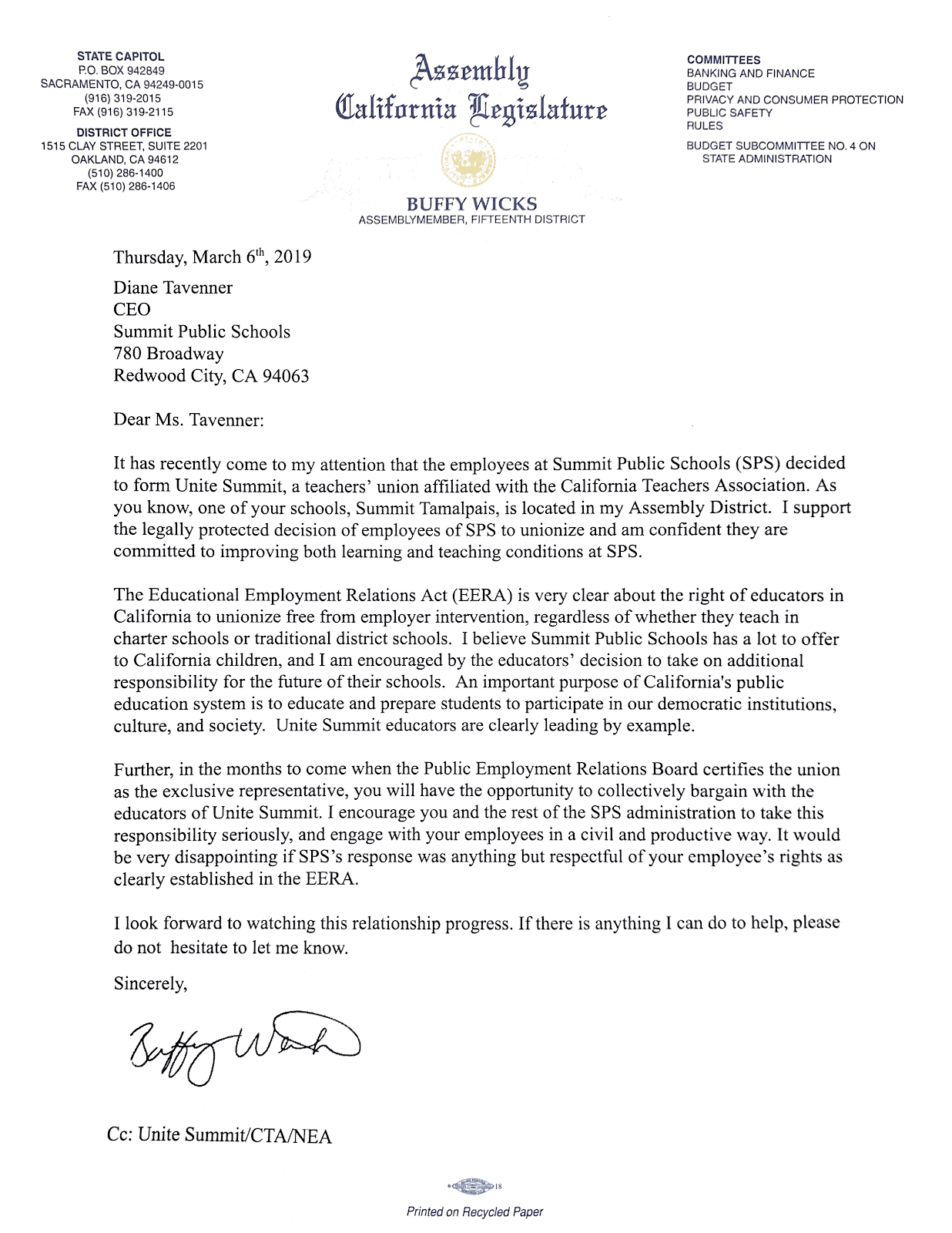
A letter from Assemblymember Wicks:

California Assemblymember Buffy Wicks from the East Bay has written the following letter in support of our organizing efforts. The full text of the letter is below:  


Newsletter: March 12

Dear Unite Summit members:

We are excited to hear your voices as we continue the process of hosting bargaining input meetings. If you have any questions on the process/would like to support in organizing in any manner, please don’t hesitate to reach out!

Attend a bargaining input meeting!

There are two bargaining input meetings left, both of which are scheduled for this week.

If you have not yet had a chance to fill out the bargaining prep survey, please do so ASAP!

We’d like to have as much data as possible to inform our work together; everyone’s voice is valuable!

You can find the survey at: https://tinyurl.com/y2bkw6ag.

If you can’t attend your site’s meeting but would like to give more input than you were able to give on the bargaining prep survey, contact your site organizers or email unitesummitteachers@gmail.com.

Update on Bargaining Team Proposals

After the first seven input meetings, our sites are roughly split between a preference for a large scale bargaining team (a representative from each site) and small scale bargaining team (a representative from each city or each region).

This decision is not solidified yet until input meetings have taken place at each school site. If you did not have a chance to express your preference at your site input meeting, please contact your site organizer so they can record your preference!

Answers to frequently asked questions:

How can I be involved in bargaining if I’m not on the bargaining team?

Our plan is to elect bargaining team representatives and then to have volunteers at each site form a Contract Action Team. Members of that team would be responsible for helping their bargaining team representative work on proposals and would work to make sure that all members at their site are fully informed about how negotiations are proceeding and can give input throughout the process. Stay tuned for more information about bargaining team elections and CAT opportunities – that is our next step after we wrap up our input meetings!


Stay tuned to www.unitesummitteachers.wordpress.com for further updates. You can also reach us at unitesummitteachers@gmail.com if you have questions or want to help with the next stages of building our union. Thank you for joining us in these exciting efforts to improve our schools in the service of students and teachers!

March 5 newsletter

Dear Unite Summit members:

We are excited to embark on this process, kicking off org-wide efforts such as our bargaining input meetings. If you have any questions on the process/would like to support in organizing in any manner, please don’t hesitate to reach out!

Attend a bargaining input meeting!

If you have not yet had a chance to fill out the bargaining prep survey, please do so ASAP – bargaining input meetings have started! We’d like to have as much data as possible to inform our work together; everyone’s voice is valuable!

You can find the survey at: https://tinyurl.com/y2bkw6ag.

Bargaining input meetings have been scheduled at each site, and our goal is to have all input meetings completed by the end of this week. So far, Rainier, Everest and Denali have completed their input meetings.

These meetings are a chance to discuss our bargaining prep survey results and add further perspective about what issues we should prioritize going into bargaining. You will have a chance to give input into how we elect our bargaining team and to offer nominations. About 50 people have been nominated so far!

If you can’t attend your site’s meeting but would like to give more input than you were able to give on the bargaining prep survey, contact your site organizers or email unitesummitteachers@gmail.com.

Update on Bargaining Team Proposals:

Based on the input provided at these 3 meetings, it seems that schools are leaning toward smaller scale bargaining teams, with a representative from each city. Please make sure you are taking the opportunity to voice your opinions on bargaining team structure in these meetings at your school site! This decision is not solidified yet until input meetings have taken place at each school site. Other options would include having a representative from each school (large scale bargaining team) or having a representative from each region (North Bay, East Bay, South Bay) — or if you have a different idea, please share!

Answers to frequently asked questions:

How long will this process take?

Based on the experience of other union charter schools, bargaining a first contract takes about a year. Subsequent contracts usually take less time to negotiate, since we would not be starting from scratch like we are with a first contract.

How does the Janus decision impact our union?

Janus is the name of a Supreme Court decision (made in June of 2018) that is part of a decades-long attack on unions, funded by people like the DeVos family and the Koch brothers. Before Janus, public sector workers in unions could be required to either join the union as members (paying full dues) or become a “fee-payer” and pay a lesser amount of money, proportional to the cost of representation and bargaining contracts.

The Janus decision means that folks no longer have to pay a fee; in other words, they can enjoy all the benefits of having a union without having to pay for it.

All that being said, Janus has not actually impacted teacher unions. As the red state rebellion and the recent teachers strikes in LA and Oakland have shown, teachers are excited to come together in their union and use their power — along with parents, students, and community — to pressure politicians to prioritize education funding and to redirect money away from central offices and bureaucracies and into the classroom.   

How is a contract ratified? What is the difference between dues and non-dues paying members’ rights within the union?

When Summit administration and our elected Unite Summit bargaining team have negotiated a contract that they think everyone can agree on, we will have a “tentative agreement.” It’s tentative because the Summit Board will have to vote for it, and we will have to vote for it.

Right now, the dues of many other educators from across the state are supporting our organizing and our upcoming contract negotiations. We will not sign up for membership or start paying dues until it’s time to vote on the tentative agreement. This means once we have a tentative agreement, we will be able to weigh the improvements we have made in our contract against the cost of dues. Only members (those who pay dues) can vote to ratify the contract.   

Unite Summit Testimonials: Why we support US!

If you would like to add your picture for why you support Unite Summit, please feel free to send your pictures to the Organizing Committee Rep at your school!


Stay tuned to www.unitesummitteachers.wordpress.com for further updates. You can also reach us at unitesummitteachers@gmail.com if you have questions or want to help with the next stages of building our union. Thank you for joining us in these exciting efforts to improve our schools in the service of students and teachers!